
China Travel News: China Is Trending, but U.S. Travelers Should Check the Visa Timeline First
China Express Visa VIP Services Tel:888-866-9909
Apply for your China visa online Apply online →
China travel is back in the conversation.
Across YouTube, TikTok, Instagram, and travel blogs, more American creators are showing the China many viewers have not seen up close: high-speed trains, clean subway systems, late-night food streets, mobile payments, giant city skylines, historic neighborhoods, tea houses, mountain scenery, and crowded tourist districts that feel both old and futuristic.
For many Americans, China is no longer only a place for business trips or family visits. It is becoming a destination people are curious to experience for themselves.
But before booking a nonrefundable flight to Shanghai, Beijing, Chengdu, Xi’an, Guangzhou, Shenzhen, or anywhere else in China, travelers should understand one practical issue:
A China visa may take longer than expected.
For many applicants, the process still goes smoothly. A straightforward tourist visa can be manageable when the application is complete, the background is simple, and the correct consular office is selected. But recent front-line visa submission experience across major Chinese consular cities in the United States shows that timing is not the same everywhere. Some applications move quickly. Others spend longer in online pre-review, wait for passport submission, or remain under additional review after the passport has already been submitted.
This does not mean travelers should avoid China. It means they should plan smarter.
The News Angle: China Travel Is Hot, but the Visa Comes First
The official China visa process in the United States is not simply “fill out a form online and wait for the passport to come back.”
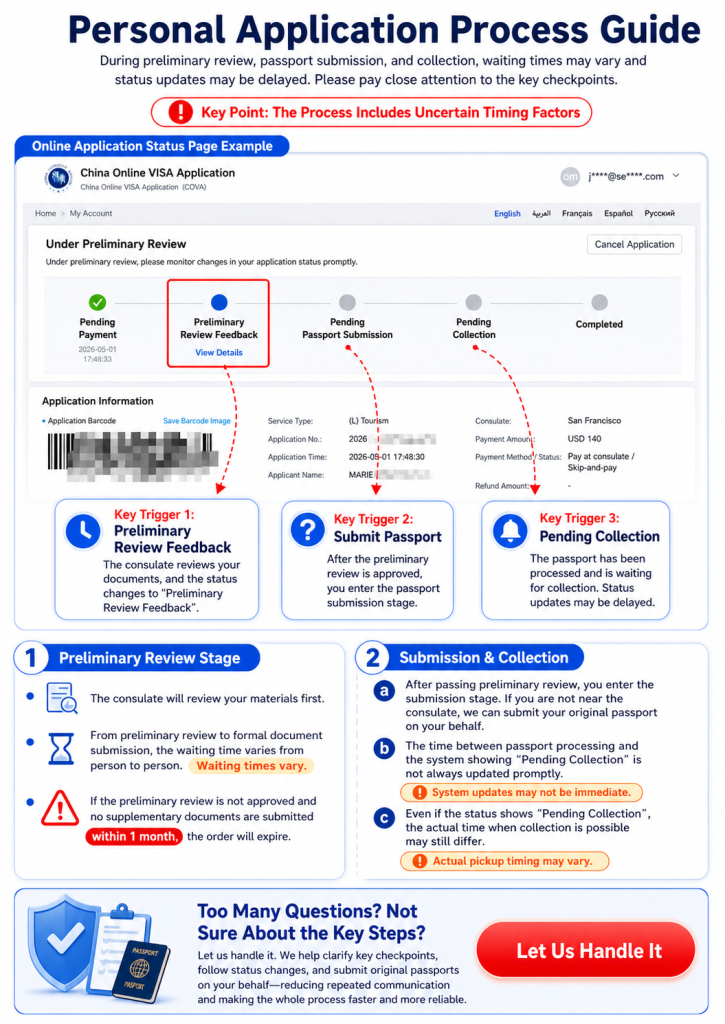
In general, applicants complete the online visa application, upload materials, and wait for online pre-review. Once the application status shows that the passport can be submitted, the applicant or an agent must bring the original passport and required documents to the appropriate Chinese Embassy or Consulate visa office.
The important point for American travelers is this:
Chinese Embassy and Consulate visa offices in the United States do not provide direct mail-in visa application service. The passport must be physically submitted after online pre-review. Once the passport is ready, it must also be physically picked up. Applicants may go in person, or they may authorize an agent or third-party visa service to handle the submission and pickup.
That is why third-party visa services exist. For someone who lives several hours from Los Angeles, San Francisco, Chicago, New York, or Washington, D.C., handling the visa alone may mean expensive gas, parking, tolls, time off work, and possibly two separate trips: one to submit the passport and one to pick it up.
“Four Business Days” Does Not Mean the Whole Process Takes Four Days
Official guidance generally lists regular visa processing as about four business days after the passport is physically submitted, if the application meets the requirements. That timing is useful, but it is not the whole picture.
It does not include:
- Filling out the online application.
- Uploading documents.
- Waiting for online pre-review.
- Correcting or supplementing materials if requested.
- Waiting until the status allows passport submission.
- Mailing the passport to a third-party service, if one is used.
- Physical submission at the correct visa office.
- Pickup after the passport is ready.
- Return shipping to the applicant.
- Extra review, notification, interview, or document requests in certain cases.
In other words, a traveler should not plan a China trip based only on the regular processing estimate. The real timeline depends on the consular jurisdiction, visa type, personal background, work history, travel history, and whether the online review goes through cleanly.
What Recent Timing Looks Like in Major U.S. Consular Cities
The following overview is based on recent observations from third-party visa submission activity near the major Chinese Embassy and Consulate visa offices in the United States: Los Angeles, San Francisco, Chicago, New York, and Washington, D.C.
Final decisions are always made by consular officers. A third-party visa service cannot decide whether a visa will be issued and cannot guarantee a fixed processing time.
Chicago: Relatively Smooth for Many Standard Tourist and Family Cases
Chicago has recently been one of the more manageable locations for standard tourist and family-visit visa applications. For applicants with complete documents, a simple background, and the correct jurisdiction, the process has generally felt more predictable than in some other cities.
That does not mean every Chicago application will be fast. Naturalized U.S. citizens who were not born in the United States, applicants with less common countries of birth, or travelers with more complicated work or travel histories may still face additional review. A smoother location does not remove the need to plan ahead.
Washington, D.C.: Generally Steady, but Not a Last-Minute Option
The Washington, D.C. visa office covers many states, so volume can be high. Recent timing has still been relatively steady compared with the slowest locations.
For standard tourist, family-visit, or routine business cases, D.C. has not shown the same level of broad delay seen in New York. Still, travelers should leave enough time for online review, document correction, passport submission, pickup, and return shipping.
For a simple trip, starting at least three to four weeks ahead is more realistic than waiting until the final week before departure.
Los Angeles: Tourist Cases Are More Normal; Business and Work Cases Need Caution
Los Angeles depends heavily on the visa type.
Standard tourist and family-visit cases have generally been more normal when the applicant’s background is straightforward and the online materials are prepared correctly.
Business and work-related visas are more likely to require additional waiting after passport submission. Some applicants may only wait a few extra business days. Others may wait longer.
Extra caution is especially important for applicants who:
- Were born in the United States but previously held Chinese nationality or Chinese identity documents.
- Have government-related employment history.
- Have work history connected to religious organizations or churches.
- Work in industries that may receive closer review.
- Are applying for business, work, training, or other non-tourist purposes.
For these applicants, a tight travel schedule is risky. A two- to three-week buffer is safer, and some cases may need more time.
San Francisco: Certain Corporate and Sensitive-Industry Cases Can Take Longer
San Francisco has not been universally slow, but some business visa applications can take longer, especially when the applicant is connected to a large company, technical field, aerospace or aviation, research, or another sensitive industry.
Even when the online application is complete and pre-review has passed, the passport can still remain under closer review after submission. The delay may not be caused by a mistake in the form. It may relate to the employer, industry, purpose of travel, or overall application profile.
For business travel, training, conferences, corporate visits, or technical exchanges, starting at least one month ahead is a safer approach. If the travel date cannot move, start earlier.
New York: The Most Patience Required Right Now
New York is currently one of the most difficult locations for travelers with tight timelines.
Online pre-review alone may take close to two weeks in some cases. After pre-review is completed, the passport may still not be submitted immediately. Once the passport is submitted, applicants with complex work backgrounds or travel history to certain countries, including Turkey, may face additional review that can take weeks.
For New York applicants, four weeks from start to finish is not unusual. For more complicated cases, six to eight weeks is a more realistic planning window.
Travelers applying through New York should be especially careful about buying nonrefundable flights before the visa timeline is clear.
Who Should Start Earlier?
Travelers should build in extra time if any of the following apply:
- The application is for business, work, study, long-stay family visit, or another non-tourist visa.
- The applicant previously held Chinese nationality, a Chinese passport, or Chinese identity documents.
- The applicant is a U.S. citizen but was not born in the United States.
- The applicant has worked for a government agency, religious organization, aerospace company, research institution, technical company, defense-related employer, or other sensitive industry.
- The applicant works for a large multinational company or a company involved in cross-border technical projects.
- The passport shows travel history to certain countries that may receive closer review.
- The application belongs to the New York jurisdiction.
- The online system has already requested corrections, supplements, or resubmission.
These factors do not mean a visa will be denied. They simply mean the traveler should not treat the process as routine or last-minute.
Why Third-Party Visa Services Are Used
For many Americans, the question is not just whether they can fill out the form themselves. The more practical question is whether they want to make the physical trip to submit and later pick up the passport.
Because the visa office does not simply mail the passport back to the applicant, handling everything personally may involve:
- Taking time off work.
- Driving several hours or flying to a consular city.
- Paying for gas, tolls, parking, or even a hotel.
- Making one trip for submission and another trip for pickup.
- Tracking updates if the case requires additional review.
A typical third-party visa service process works like this:
- The applicant completes the online application and uploads materials.
- After online pre-review passes, the applicant mails the passport and required physical documents to the third-party visa service.
- The service submits the passport at the correct Chinese Embassy or Consulate visa office.
- When the passport is ready, the service picks it up.
- The passport is shipped securely back to the applicant.
It is important to remember: a third-party visa service cannot decide whether the consulate will issue the visa and cannot promise that the visa will be completed in a certain number of days. Visa approval, visa type, number of entries, validity, duration of stay, requests for additional documents, and interview requirements are all decided by the consular office.
What a third-party service can do is reduce avoidable mistakes, monitor the online review status, handle physical submission and pickup, and provide realistic timing guidance based on current local conditions.
How to Choose a Third-Party Visa Service
If a traveler decides to use a third-party visa service, it is worth checking whether the service:
- Understands the current online pre-review and physical submission process.
- Has practical coverage near Los Angeles, San Francisco, Chicago, New York, and Washington, D.C.
- Can follow current submission patterns in different consular jurisdictions.
- Clearly explains possible timing risks before the passport is sent.
- Does not promise guaranteed approval or guaranteed processing in a fixed number of days.
- Has a clear process for passport mailing, submission, pickup, and return shipping.
The point of using a third-party service is not to bypass consular rules. It is to manage the process more efficiently within those rules, especially for applicants who live far from a visa office.
Practical Timing Advice
For a simple tourist or family-visit visa with a clean background, starting at least three to four weeks before departure is a safer plan.
For business, work, training, conferences, or more document-heavy cases, start four to six weeks ahead.
For New York cases, sensitive work backgrounds, prior Chinese nationality, complicated travel history, or trips with fixed dates, start six to eight weeks ahead if possible.
The safest rule is simple: do not build the entire trip around the fastest possible visa timeline.
Final Word: China Travel Is Exciting, but the Visa Timeline Matters
China can be an exciting trip for American travelers, whether the draw is food, history, high-speed rail, city life, mountains, family, business, or simply seeing the country beyond headlines and short clips.
But before the trip begins, the visa is still one of the most important planning steps.
Before booking a flight, travelers should ask three questions:
- Is a visa required, or does the trip qualify for a visa-free or transit exemption?
- Which Chinese Embassy or Consulate jurisdiction handles the application?
- Could the applicant’s work history, nationality history, or travel history lead to additional review?
Answering those questions early can prevent a lot of stress later.
China travel may be trending, but smart travel still starts with the basics: the right visa, the right timeline, and a plan that does not depend on luck.
Public information reviewed:
- Chinese Embassy in the United States: Chinese Visa Application Frequently Asked Questions (Updated September 2025)
- Chinese Embassy in the United States: Requirements and Procedures for Chinese Visa Application (Updated September 2025)
- Chinese Embassy in the United States: Consular jurisdiction information for Chinese Embassy and Consulates-General in the United States